Dynamic identification · United Kingdom

Cable-stayed footbridge

Pennyferry · steel footbridge in Durham

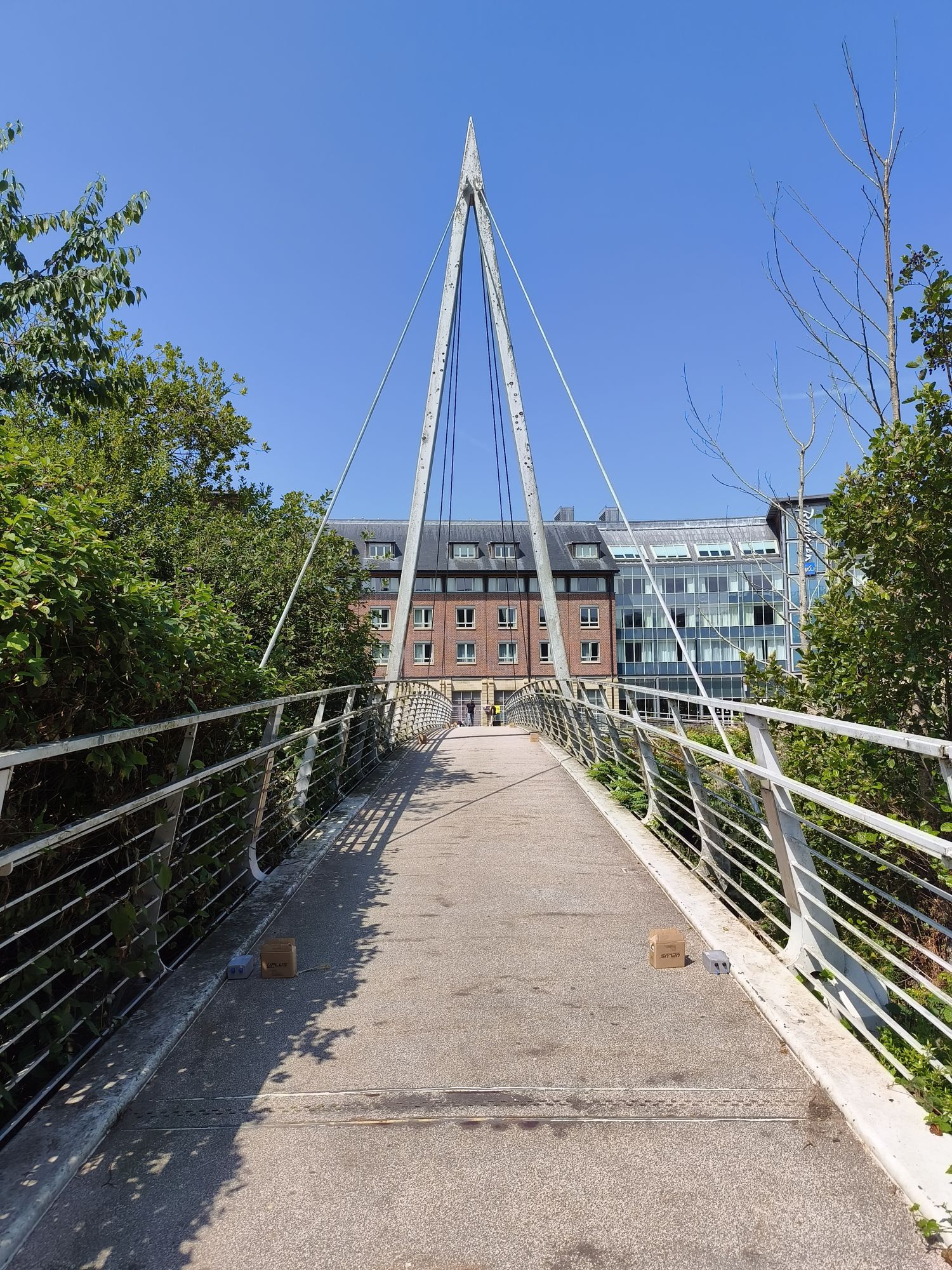
The cable-stayed footbridge seen from the deck, with the pylon and stay cables
The bridge seen from the deck. Photo: Giuseppe Occhipinti.
01

Knowing

Cable-stayed footbridges are light, slender structures with closely spaced vibration modes that are sensitive to people walking across them. Knowing their actual dynamic behaviour is the starting point for assessing comfort and safety and for setting up monitoring.

The footbridge is about 60 m long and 3.4 m wide: its steel deck is carried by six stay cables connected to an asymmetric pylon. The study was carried out in 2026 for Durham University and also served as a field test of the QMEMS accelerometer measuring platform.
02

Measuring

The ambient vibration campaign took place on 16 July 2026 and lasted about three hours, with the bridge open to normal pedestrian traffic: no closure and no interaction with the people crossing it.

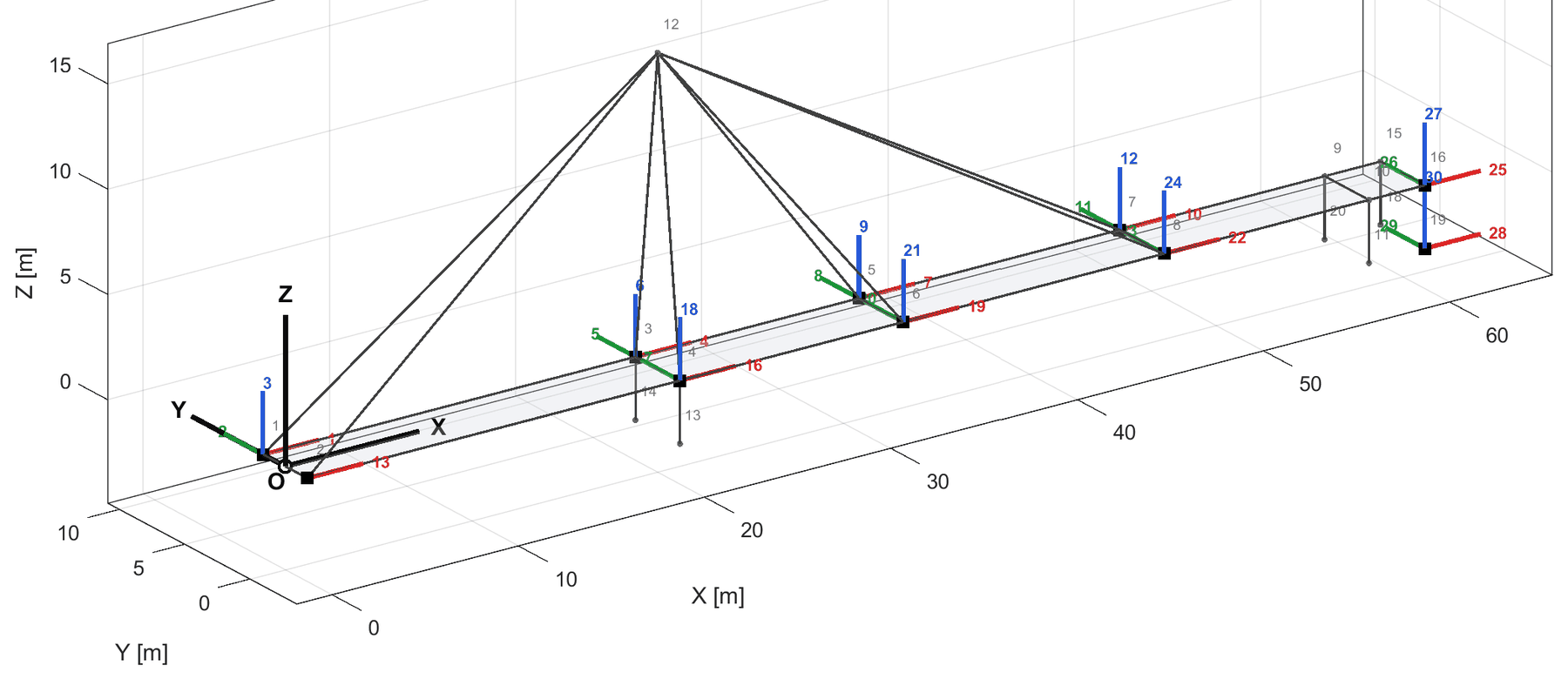
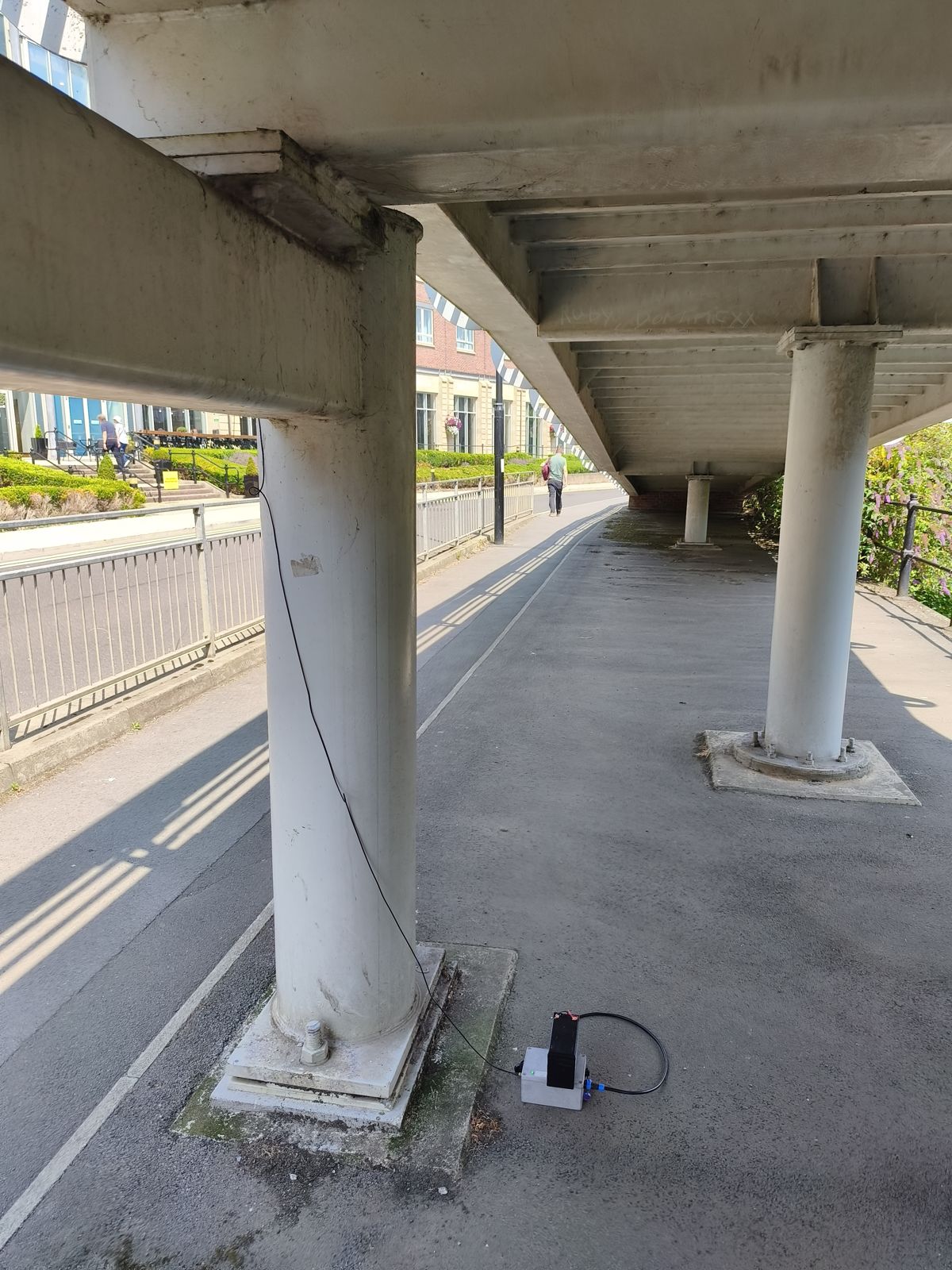
The pylon could not be accessed, so the network was designed on the deck to make the main vibration modes clearly observable: nine Smart Sensor Boxes with Epson M-A370 QMEMS accelerometers and one reference station on the ground, 30 channels in total. Each box records its data locally, with no cables to a central system. In the main frequency range the deck amplifies the motion by about 40 dB compared with the ground.

3D layout of the footbridge with sensor positions and X, Y, Z measurement directions
Position of the Smart Sensor Boxes on the deck and measurement directions: X in red, Y in green, Z in blue.
03

Modelling

Frequencies, damping ratios and mode shapes were identified with the SSI-UPC method (Stochastic Subspace Identification). The stabilization diagram shows stable poles from low model orders up to the highest ones: a sign of good-quality measurements.

Twelve stable modes were identified between 0 and 8 Hz, grouped in two clusters of closely spaced frequencies: about 1.8–3.7 Hz and 5.2–7.8 Hz. The mode shapes can be explored in 3D at the bottom of the page.

Modes identified through operational modal analysis.
ClusterRange [Hz]Modes
11.816 – 3.71112 stable modes in total, between 0 and 8 Hz
25.228 – 7.770
04

Outcome

Twelve modes identified in three hours, without stopping pedestrian traffic.

The split into two frequency clusters is typical of decks hung from several stay cables, where each anchorage acts as an elastic support. The first and third mode shapes confirm it: the deck does not behave as a continuous suspended beam, but as a sequence of spans on elastic supports.

The campaign also confirmed that the QMEMS platform delivers reliable operational modal analysis even on light structures with very closely spaced modes.

Images

Smart Sensor Box and battery at the base of the bridge

Publications

  1. 2026Performance evaluation and field validation of next-generation QMEMS accelerometers for seismology, structural health monitoring, and impact-based earthquake early warning
    Patanè D., Todorokihara M., Fertitta G., Martino C., Occhipinti G., Sicali A., Sabella F. Sensors 26, 5528. DOI 10.3390/s26175528

Dynamic identification · 16 July 2026

Identified mode shapes

Vibration modes of the bridge identified from ambient vibrations with operational modal analysis. Pick a mode from the list, drag the 3D view to rotate it and start the animation to see the shape in motion.

Processed with the GOES OMA/SHM Toolbox · normalised shapes, amplitude magnified for readability

Contact

Tell us about your structure.

+39 339 5003643
info@giuseppeocchipinti.it
Via Ottorino Respighi 34
97100 Ragusa · Italy
VAT IT01335650881 · PEC giuseppe.occhipinti2@ingpec.euPrivacy · CookieVerba volant, data manent
Style