
Dynamic identification · Norway

Herøy FoU

Herøysund and Skattørsundet bridges

Herøysund bridge with scaffolding, reflected in the fjord
Herøysund bridge during the works. Photo: Giuseppe Occhipinti.
01

Knowing

The old Herøysund bridge, in Nordland county, was chosen as a pilot site to study how bridge collapses can be prevented in the future. UiT The Arctic University of Norway, the Norwegian University of Science and Technology (NTNU), the research institute SINTEF Narvik, Nordland county (Nordland Fylkeskommune) and the Norwegian Public Roads Administration (Statens Vegvesen) worked together on a research project called "Herøy FoU", with a budget of just under 6 million Norwegian kroner (NOK). The report focuses on ambient vibration measurements and on loads from vehicle traffic, using Operational Modal Analysis (OMA).

02

Measuring

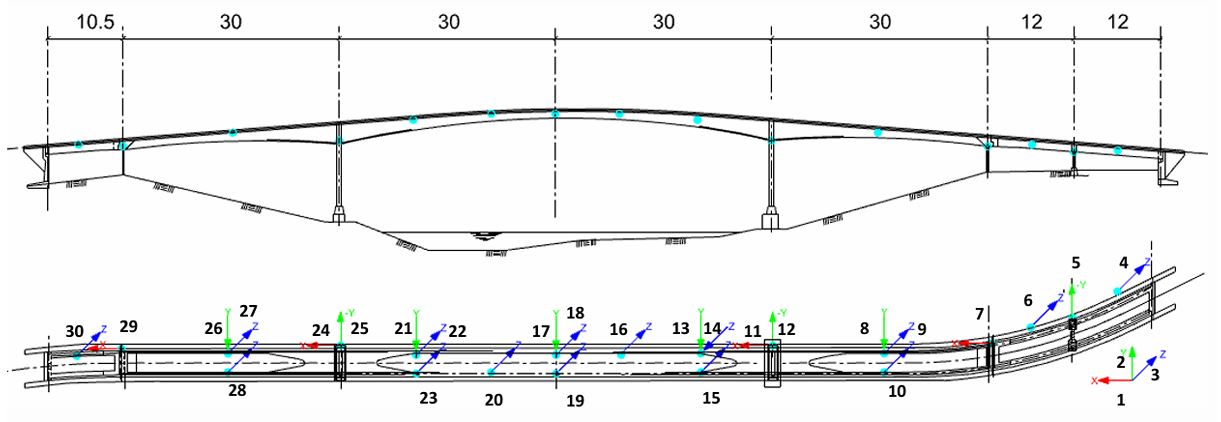
The sensors were installed under the bridge deck, reached from a scaffold. Before going ahead, the installation plan had to be revised and the most effective anchoring system tested, both for data quality and for speed of installation.

Layout of the measurement points on the deck
Layout of the measurement points.
03

Modelling

The structure was analysed with numerical models, both linear and nonlinear, for dynamic identification; this work was also the subject of several master's theses. For the numerical modelling, different approaches were adopted — including the widely used finite element method (FEM) and the more innovative DMEM — to predict and simulate the static and dynamic behaviour of the bridge. Three programs were used for the numerical simulations (HISTRA for DMEM, LUSAS and ANSYS for FEM).

04

Outcome

The OMA results showed consistently stable frequencies for the identified vibration modes. In most cases these modes were detected reliably, demonstrating the robustness of OMA and the accuracy of the sensors and of the acquisition architecture. In some cases, however, one or more modes were not identified. This can be attributed to localised oscillations or spikes in the raw data records, which can adversely affect the OMA results. It is worth noting that the first vibration mode was identified consistently in every analysis, with a stable frequency and a mean value of 1.64 Hz. This suggests that the first mode is particularly robust and unaffected by small disturbances in the data. Modes two to six were also detected in most of the analyses, with minimal frequency variation, confirming the overall stability of these modes over time.

Images

Report

Publications

  1. 2024 Dynamic Analysis of Herøysund Bridge using Finite Element Modelling and Operational Modal Analysis
    Singh,Harpal; Occhipinti,Giuseppe; Storni,Daniele. A Technical Report, December 2024

Dynamic identification · 22 June 2023

Identified mode shapes

Vibration modes of the bridge identified from ambient vibrations with operational modal analysis. Pick a mode from the list, drag the 3D view to rotate it and start the animation to see the shape in motion.

Processed with the GOES OMA/SHM Toolbox · normalised shapes, amplitude magnified for readability

Contact

Tell us about your structure.

+39 339 5003643
info@giuseppeocchipinti.it
Via Ottorino Respighi 34
97100 Ragusa · Italy
VAT IT01335650881 · PEC giuseppe.occhipinti2@ingpec.euPrivacy · CookieVerba volant, data manent
Style