Built heritage · Rome

Monalisa

Sarcophagus of the Spouses · National Etruscan Museum of Villa Giulia

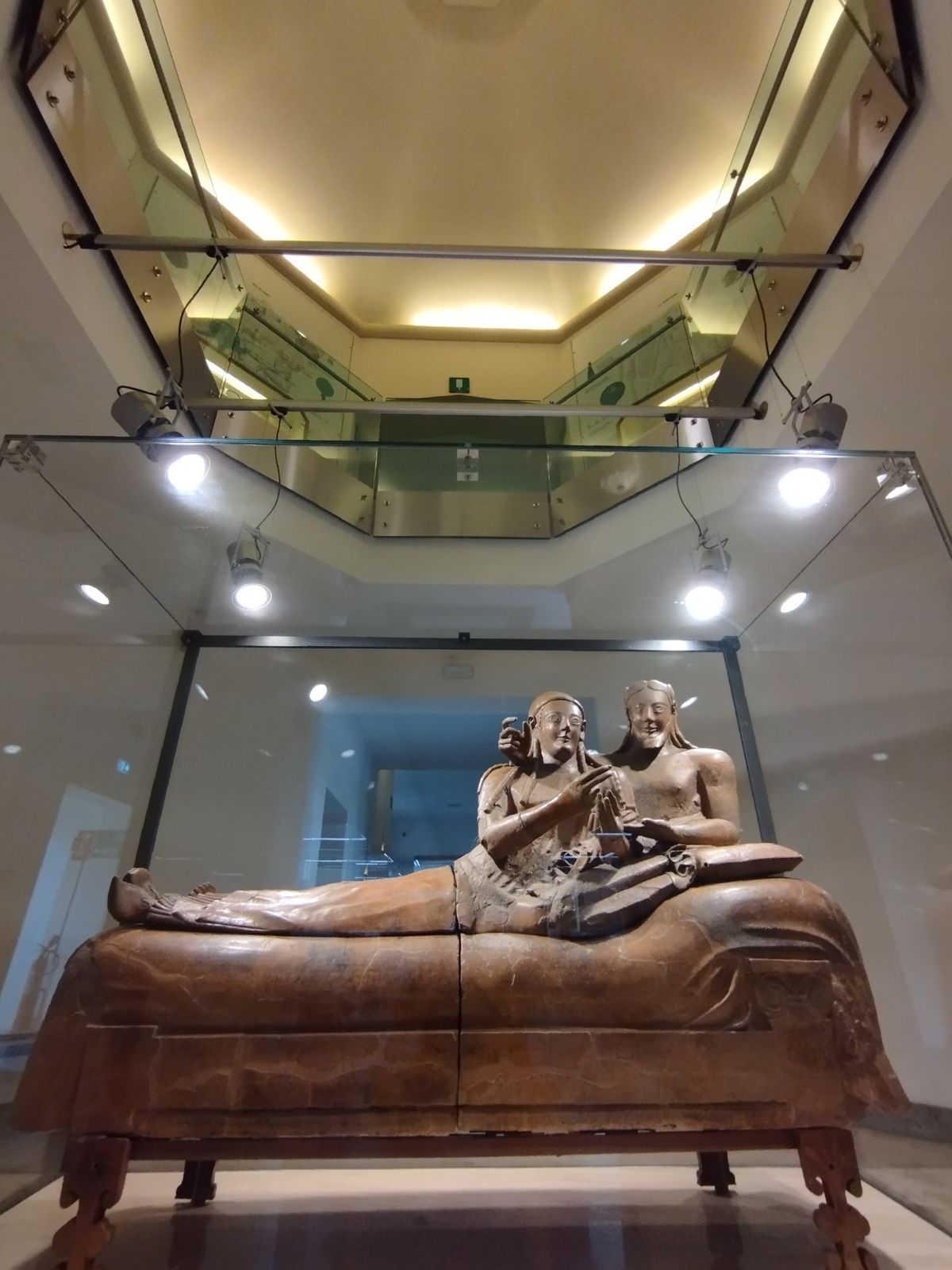
The Sarcophagus of the Spouses in its glass and steel case in the middle of the room
The Sarcophagus of the Spouses in its case, in the middle of the museum room. Photo: Giuseppe Occhipinti, 2022.
01

Knowing

The Sarcophagus of the Spouses, probably a cinerary urn from the 6th century BC found in Cerveteri in 1881, depicts a married couple at a banquet. It is made of hollow terracotta of varying thickness in four parts: its roughly 400 fragments were reassembled with glue and metal bands, and internal metal struts form frame-like structures. The work is already cracked and its surface is fragile; it is displayed in a glass and steel case in the middle of the room, on a floor laid directly on the soil.

The room is very close to a tram line and lies above an underground railway, while heavy road traffic passes outside the museum. The study, part of the MONALISA project (active monitoring and vibration and seismic isolation of works of art) at Sapienza University of Rome, had to provide the dynamic properties of the work in order to design a vibration isolation system.
02

Measuring

The museum did not allow contact sensors or laser vibrometers. Vibrations were measured with four GPS-synchronised triaxial velocimeters at the corners of the case, at 200 Hz for about two hours: 27 main events, 12 tram and 15 train passages. The vertical component is the strongest, below 0.4 mm/s for trains and between 0.6 and 1.6 mm/s for trams, close to or above the thresholds in the literature and in codes. A second campaign a few months later recorded more passages and larger vertical peaks.

For contact-free dynamic identification, motion magnification was applied to short videos shot with an ordinary tablet on a tripod (720 × 1280 pixels, 30 frames per second) right after a tram passage: every pixel becomes a virtual sensor. At 30 frames per second the analysis is limited to frequencies up to 11 Hz.

03

Modelling

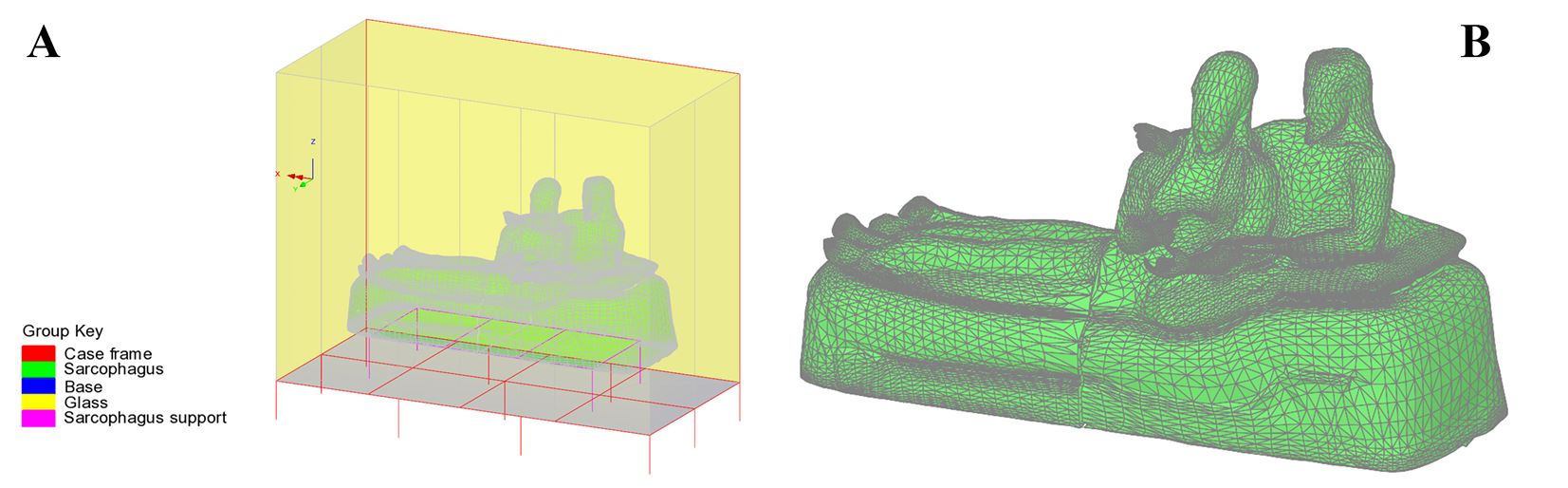
The geometry comes from a structure-from-motion survey of the statue: the mesh of 1,733,261 triangular faces was reduced to 13,310 quadrilateral faces, keeping the discontinuity between legs and busts. The finite element model, built in LUSAS, represents the terracotta with shell elements and includes the case with its steel frames and support, for about 90,000 degrees of freedom.

The average thickness (32 mm) and Young's modulus (2 GPa) of the terracotta were calibrated on the frequencies measured from the video; the density comes from weighing the case and a single glass pane.

Finite element model of the Sarcophagus with and without the case
Finite element model of the Sarcophagus (A) with and (B) without the case.
04

Outcome

The dynamic properties of a fragile work of art, obtained without touching it.

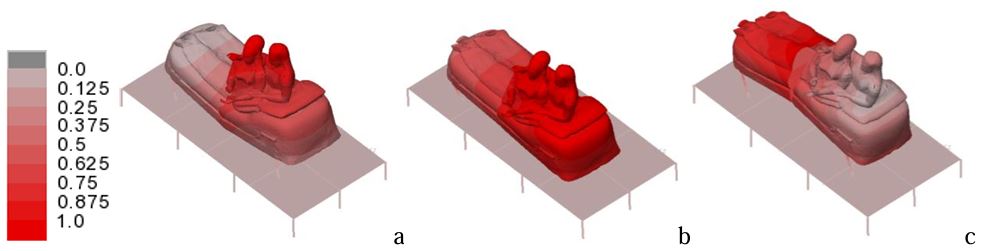
The first four modes identified from the video are in reasonable agreement with the calibrated model. The first three modes have frequencies of 6.4, 8.0 and 9.4 Hz and mainly involve the busts, with the largest displacements at the heads, hands and cushion edges; the steel support strongly affects the mode shapes.

The calibrated model is the basis for designing the isolation from traffic vibrations, which the study suggests combining with horizontal isolation for seismic protection.

Total modal displacements of the first three modes
Total modal displacements of the first (6.4 Hz), second (8.0 Hz) and third (9.4 Hz) modes. Glass panes hidden for clarity.

Images

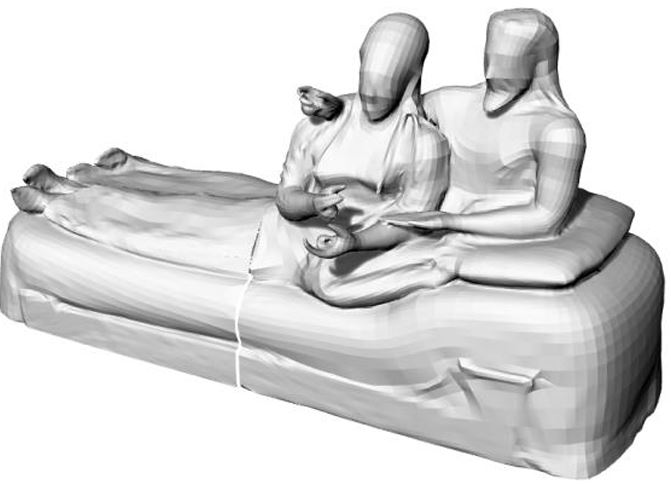
3D model of the Sarcophagus of the Spouses

Publications

  1. 2025Dynamic identification of the Sarcophagus of the Spouses by means of digital video analysis
    Fioriti V., Occhipinti G., Roselli I., Cataldo A., Clemente P., Colucci A., AlShawa O., Sorrentino L. Heritage 8(4), 133. DOI 10.3390/heritage8040133
  2. 2023Structure from motion survey of statue for finite element modelling
    Vincenti M.A., Caponero M.A., Lamonaca M., Occhipinti G., AlShawa O., Sorrentino L. COMPDYN 2023, Athens

Contact

Tell us about your structure.

+39 339 5003643
info@giuseppeocchipinti.it
Via Ottorino Respighi 34
97100 Ragusa · Italy
VAT IT01335650881 · PEC giuseppe.occhipinti2@ingpec.euPrivacy · CookieVerba volant, data manent
Style