Dynamic identification · Norway

Skattørsundet

Reinforced concrete slab bridge, 804 m long · Skjervøy

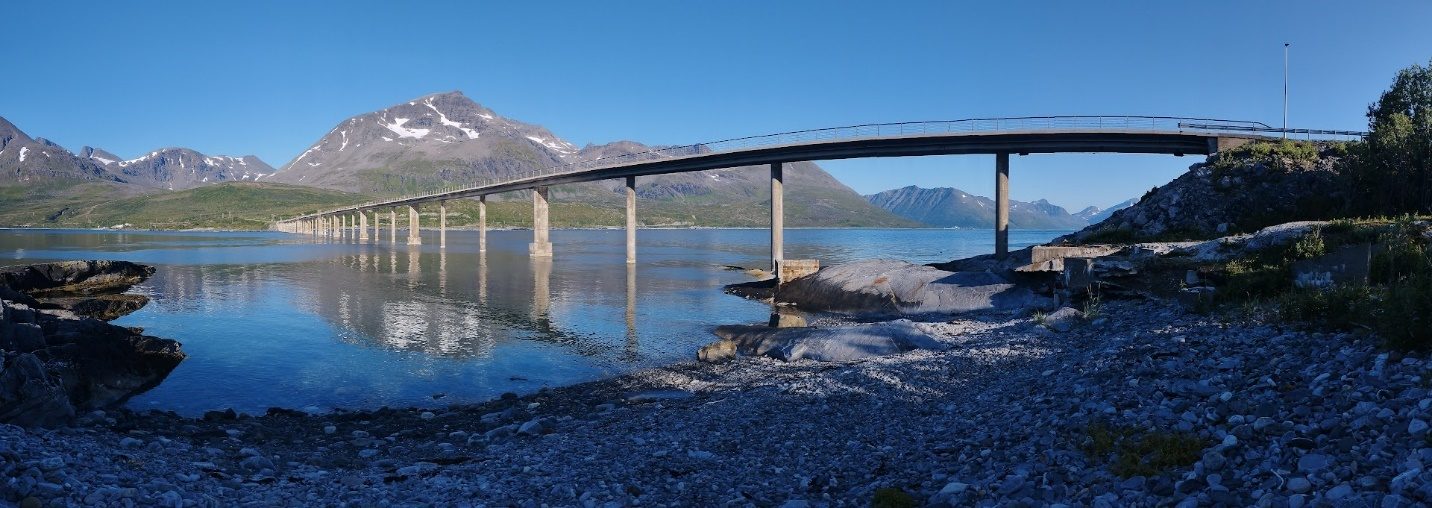
The Skattørsundet bridge across the fjord, with its concrete piers and mountains behind
The Skattørsundet bridge between the islands of Kågen and Skjervøya. Photo: Giuseppe Occhipinti.
01

Knowing

Many European bridges are more than fifty years old and do not meet current codes, yet they remain an essential part of the road network. In northern Norway the issue is plain: according to a 2017 report by Statens vegvesen, about half of the country's 16,791 bridges lacked adequate inspection and about 1,087 showed serious or critical damage.

The Skattørsundet bridge links the islands of Kågen and Skjervøya, in Troms og Finnmark county, and is a strategic connection: together with the Maursund tunnel it joins Skjervøy to the mainland. It is a reinforced concrete slab bridge opened in 1971, 804 m long, with a longest span of 32 m, divided into four parts by three expansion joints.

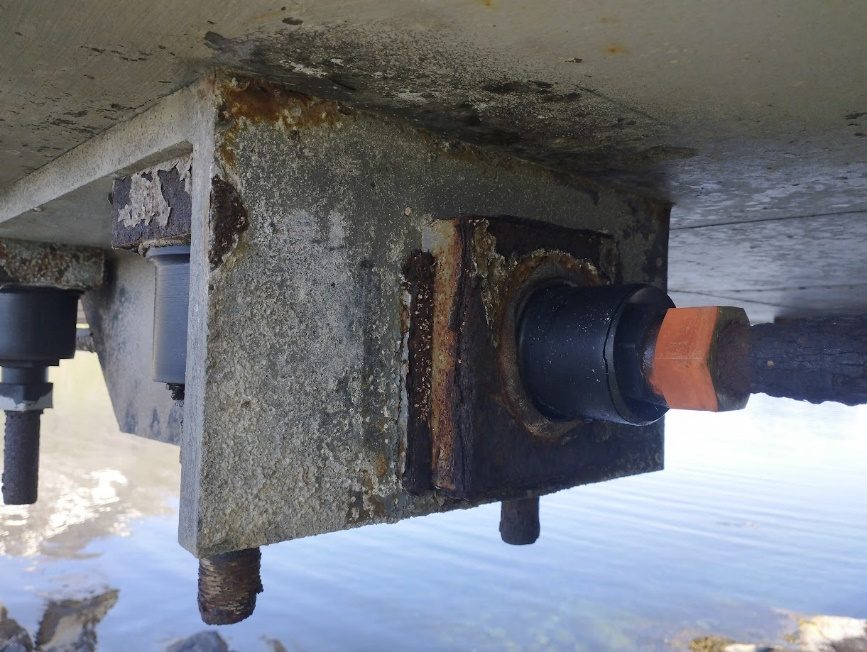
The survey of 10 July 2024 revealed heavily degraded and probably locked bearings, marked section loss at the base of several piers, cracks in the abutment walls and corroded external post-tensioning bars.
02

Measuring

The operational modal analysis campaign took place between June and July 2024, at night only and without closing the bridge. It used 16 high-sensitivity piezoelectric accelerometers (PCB 393B12, 10 V/g), two synchronised LEAP DAQ units and an acquisition server: signals recorded at 1000 Hz in 30-minute acquisitions were resampled to 20 Hz for identification.

With 39 piers and two abutments the whole bridge could not be instrumented at once, so the measurements were organised in five campaigns, with multirun layouts overlapping at a few points.

Measurement campaigns on the Skattørsundet bridge.
DateCampaignGoal
19 June 2024Spot analysisChecking the FE model at a few points (piers 8–13 and 18–28)
11 July 2024OMA with trafficMain span, six sensors along the deck edge
12 July 2024Longitudinal behaviourOne acquisition for each of the four parts between joints
13 July 2024Multirun on the whole bridgeThree layouts of 16 sensors for the transverse modes
14 July 2024Multirun on the main spanFour layouts, without traffic
03

Modelling

A finite element model with thick beam elements (LUSAS) was built from the original drawings, without the post-tensioning tendons for lack of data. The first fourteen computed frequencies lie between 0.91 and 1.93 Hz, with non-uniform mode shapes involving only parts of the bridge: so the model was used first of all to decide where to place the sensors, and it was checked against the spot tests of 19 June.

The first frequencies identified with the 13 July multirun are close to those of the uncalibrated model, showing that the lowest transverse modes depend mainly on the pier stiffness. For higher modes the measured frequencies are lower than the computed ones, as if the deck concrete were less stiff than assumed or degraded.

First three frequencies: FE model and OMA campaign of 13 July 2024.
ModeFE model [Hz]OMA [Hz]
10.9090.857
20.9780.930
31.0190.946

On the part containing the main span the model was then updated automatically (MuDI software), changing the elastic modulus of 40 portions of deck and piers to reduce the gap with the measurements: the final result has a MAC of 0.937.

04

Outcome

The measurements show where to look: locked bearings and a softer zone around the main span.

The first part has no longitudinal modes: it is rigidly connected to the abutment, as the survey suggested. The second part vibrates longitudinally at 1.224 Hz, the third and fourth at about 1.915 Hz: the second part is therefore more flexible, because of taller piers or stiffness reduced by damage or deterioration.

On the 32 m main span the maximum modal displacement does not fall at midspan despite the symmetric geometry, and the mode shapes show an irregularity near pier 12. Model updating concentrates the stiffness reduction in the third and fourth spans and in the second pier of that part: the places to target in the next investigations.

Images

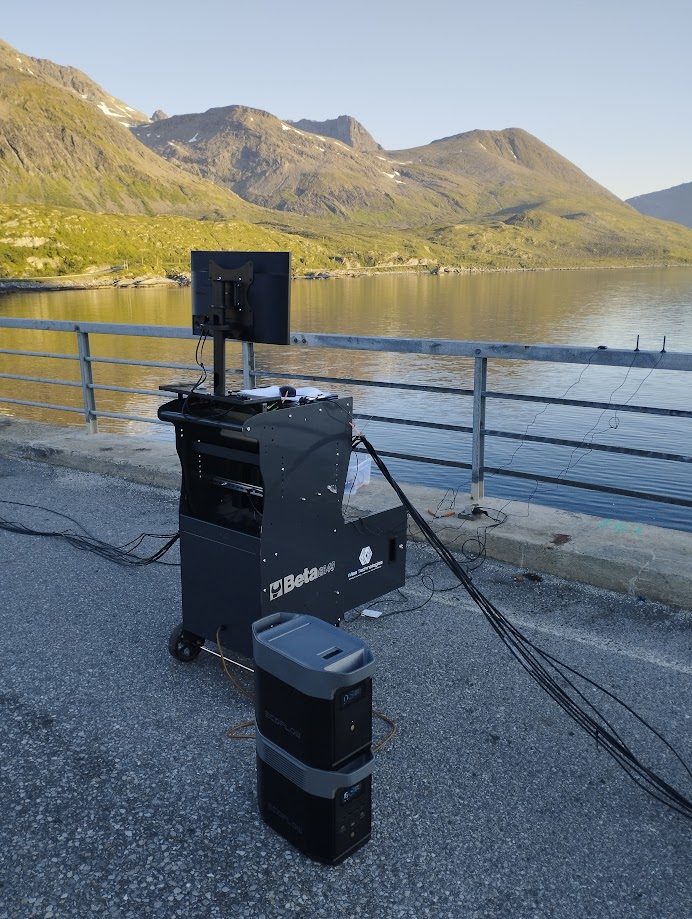
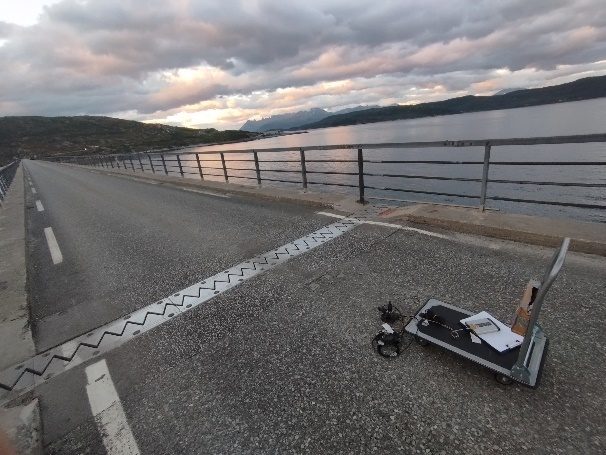
Sensors and cables on the deck during a night measurement Degraded bearing with a corroded post-tensioning bar under the deck The acquisition system on the bridge deck

Publications

  1. 2024OMA campaign on the Skattørsundet bridge
    Singh H., Occhipinti G., Storni D. Technical Report, December 2024

Contact

Tell us about your structure.

+39 339 5003643
info@giuseppeocchipinti.it
Via Ottorino Respighi 34
97100 Ragusa · Italy
VAT IT01335650881 · PEC giuseppe.occhipinti2@ingpec.euPrivacy · CookieVerba volant, data manent
Style